
Your First Event
1. Choosing your event
Already have an event picked out? Great! If not, there are lots of ways to pick an event with which to get started :
- Look through the list of upcoming events on our events calendar.
- Visit our events page - there you will find a list of all of our events in the coming weeks.
- Explore our maps page to find upcoming events on a map near you.
2. Preparation
Once you've chosen your event, there are a few things you need to know:
Clothing:
Wear hiking or running clothing suitable to the weather and footwear that can get wet. If running off trail (non-novice course), it is best to wear full leg and arm covering in the woods to protect yourself from nature's hazards.
Equipment:
Bring a compass and whistle if you have them, although we can sell/rent them to you if needed. Bring your water bottle. You may want to carry it on course or just have it for when you finish. There will be water at the finish for refills but we do not provide plastic cups.
Event details
Important event details are available on the event page by clicking on the event on our events page you'd like to attend.
Safety and commitments:
Read this document to understand what we expect of all participants for a safe and enjoyable event for all.
It might also be a good idea to brush up on your knowledge of orienteering maps before the big day. You can find all you need to know to get started on our maps page. When you arrive on site you can join the mini-clinic at 10:30 to get some help with this.
If you have a printer at hand, download and read these pages from o-store.ca. If you plan to run an intermediate course you will want to carry a copy. Another handy guide that will give you some key pointers can be found in this All About Orienteering pdf.
3. Getting there
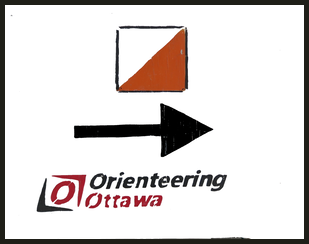
The location of the event should be clearly marked on the event page. Once you get close to the event site (the last two or three corners on the road) you can expect to see signs with the standard orange and white orienteering flags on them pointing the way to event parking.
4. Registration
SAVE TIME AT REGISTRATION BY PROVIDING YOUR PERSONAL INFORMATION IN ADVANCE.
If you have never attended an Orienteering Ottawa event before, you can complete a pre-registration form at home 48 hours in advance. By providing your personal information here in advance of the event, we can include you in our on-site database, give you a better chance to read the waiver before online acceptance, make the registration process faster for you and speed up registration for all. There is no charge at this point - the final registration and payment will be on-site on the day of the event.
When you get to the event site, look for registration tents and tables at the Orienteering Ottawa or Information banner.
Our registration is done on tablets. Find (or line up for) one. There will be someone close by to guide you through. Payment can be made by cash, cheque, or credit card.
As a general rule, our events offer multiple courses with differing physical and technical difficulties. Part of completing the registration involves writing in your choice of course. The novice and intermediate course maps will be on display at registration so you can check them out to help you choose. The advanced course maps will often only be available at the start but climb and distance measures will be displayed at the start. If you're not sure which course you want to do you can ask any of our experienced volunteers and they will help point you in the right direction.
A few notes:
- Whistles are mandatory: you will be sold a whistle for $2 if you don't have one.
- Compasses and timing chips are available for rent as well as a deposit for the compasses.
- We require the car license plate number of the car you arrived in - this is a safety precaution so please note it before you approach the registration tablets.
- If you are running with a friend, you will need to choose a team name. Our timing system cannot record multiple names.
When you complete your registration on the tablet you will be given a small chit to take to the registrar for payment and there you will be given a map, and, should you need them, a compass and timing chip.
5. Need a hand?
At this point you are ready go but if you are new to the sport or need a quick refresher....
We offer a free Mini Introduction to Orienteering clinic at our regular Sunday events. No pre-registration is needed for this clinic but we ask that you complete your event registration and have your map available for the 10:30 start. The mini-clinic instructor will call out for participants to gather. The instructor will cover the event type, general procedures (SI stick, Clear and Check, finish process etc), safety information and basic map reading/navigation pointers.
When you're ready to go you can head on over to the start.

6. At the start
When you get to the start you need to 'clear' and 'check' your timing chip in the two timing units marked as such. If you don't do this the system won't record a start time for you.
Once you've done that you can start by inserting your timing chip in the 'start' box. Please leave a minute or two of space between yourself and other competitors on the same course. This way the event is more enjoyable for everyone.

7. Finishing
The finish control is generally marked by a large FINISH banner. When you've finished you need to download at the same spot you registered with the timing official.
It is critical that you check in (download your timing chip) with the timing official whether you finished the course or not. It is also very important that you be back by the course closing time (2 pm for most Sunday events). If you are not back by then we will initiate search procedures.
8. Post Race
Congrats on a successful orienteering event!
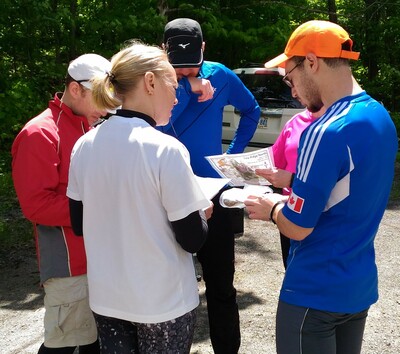
Now that you've downloaded and have your personal results in hand you can stick around to compare results and stories with others. The friendly atmosphere between competitors is really one of the things that makes orienteering so special so we invite you to cheer on your fellow competitors as much as you can.
Then chat with others about your run. Compare notes on route choices. Clarify any points with which you had difficulty. Take a look at the results likely posted on site but always posted on the web within a day or two. See where you did well and where you had problems. Review your map and see if there was, possibly, a better route choice. Don't hesitate to approach experienced orienteers if you have questions or would like advice on how you might have done better. We are all happy to share.